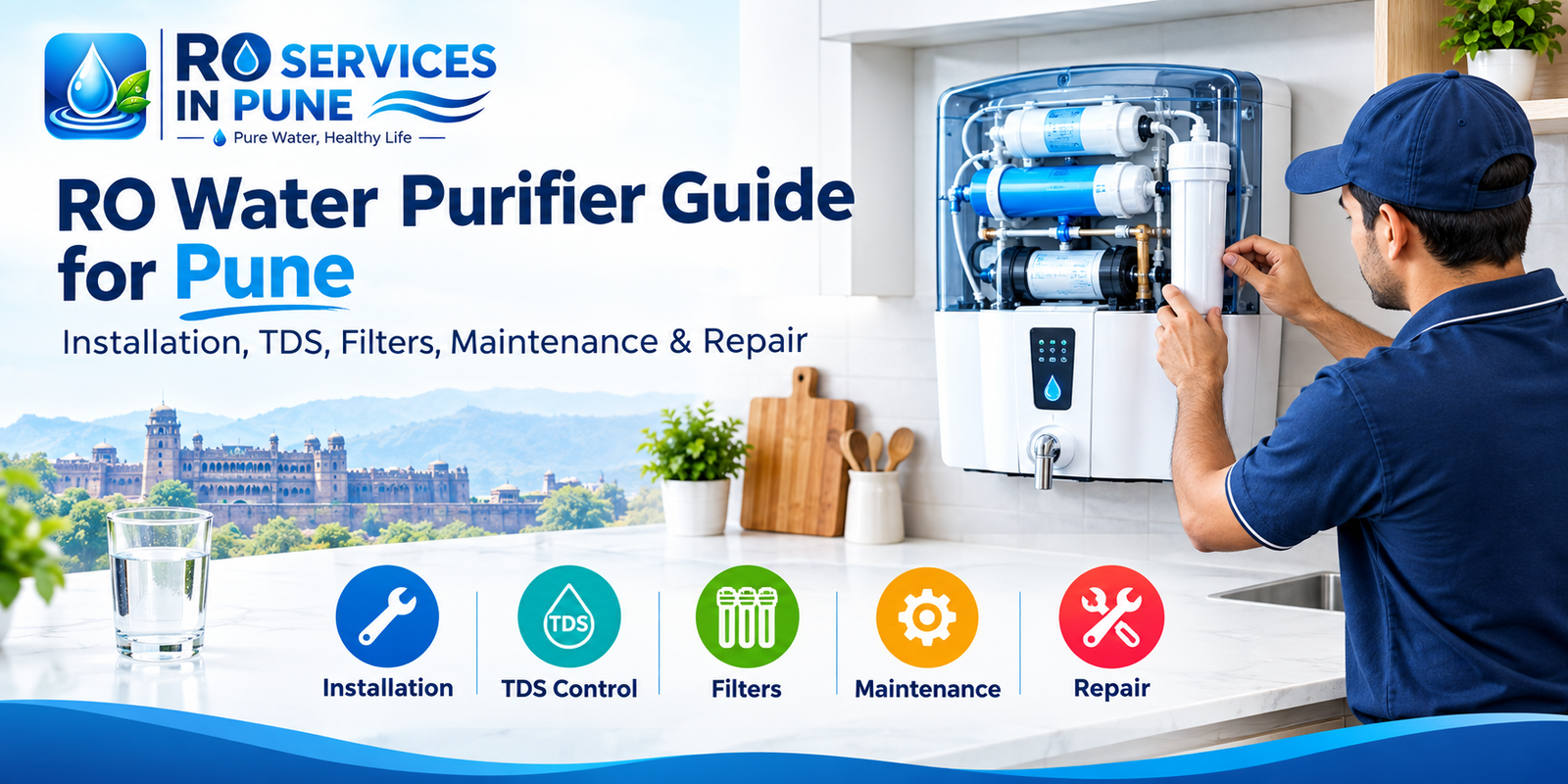
An RO water purifier is now a common part of many Indian homes, but choosing, installing and maintaining one is not always straightforward. Terms such as RO, UV, UF, TDS, membrane, sediment filter, carbon filter and mineral cartridge can make water purification seem more complicated than it needs to be.
For Pune households, the right approach starts with understanding the water entering your home. Municipal water, borewell water, tanker water and stored water can have different characteristics, so the same purification setup may not be appropriate for every property.
This guide explains what an RO water purifier is, how RO purification works, the main components, TDS, RO membranes and filters, RO vs UV, installation, maintenance, water testing and common problems. The aim is to help homeowners understand their system and make more informed maintenance and water-treatment decisions.
If you are researching professional options for your home, you can also explore RO services in Pune to understand the different types of assistance available.
What Is an RO Water Purifier?
RO stands for Reverse Osmosis. An RO water purifier uses pressure to push water through a semi-permeable membrane.
The membrane allows water to pass through while restricting many dissolved substances. The system then separates the treated water from a rejected or concentrated water stream.
However, an RO membrane is only one part of a complete purification system.
A typical RO water purifier may contain:
- Sediment filter
- Activated carbon filter
- RO membrane
- UV or UF stage
- Mineral or remineralisation cartridge
- Post-carbon filter
- Storage tank
- Pump and electrical components
The exact combination depends on the purifier model.
This means two RO purifiers can have different designs, filtration stages and maintenance requirements even though both use reverse osmosis technology.
How Does an RO Water Purifier Work?
Understanding how RO water purification works becomes easier when the process is divided into stages.
1. Sediment Filtration
Incoming water commonly passes through a sediment filter first.
This stage helps reduce suspended particles such as:
- Dust
- Sand
- Rust particles
- Mud
- Other larger suspended matter
Pre-filtration is important because it helps protect the later stages of the purifier.
2. Activated Carbon Filtration
Water may then pass through an activated carbon filter.
Carbon filtration is commonly used to improve taste and odour characteristics and reduce certain substances that can affect the water-treatment process.
The carbon stage can also help protect the RO membrane from particular feed-water conditions.
3. RO Membrane Filtration
The water then reaches the RO membrane.
Pressure forces water through the membrane, while many dissolved substances are restricted from passing through as readily.
This is the central process that makes reverse osmosis different from simpler filtration methods.
4. Additional Purification
Depending on the model, water may then pass through UV, UF, mineral or polishing stages.
Some systems use multiple technologies together because each stage serves a different purpose.
5. Storage
The purified water may be stored in a tank before being dispensed.
This means that maintaining the storage tank is also an important part of overall purifier hygiene.
For households that need tank cleaning or descaling, professional tank sanitization can be considered as part of routine maintenance.
RO Water Purifier Components Explained
Understanding the main components can help you recognize why different parts require different types of maintenance.
RO Membrane
The RO membrane is one of the most important components in the system.
Its performance can be influenced by:
- Incoming water quality
- Water pressure
- Feed-water temperature
- Pre-filter condition
- Scaling
- Fouling
- Usage
- Membrane age
A membrane should not be replaced simply because a purifier has reached an arbitrary age. Its condition and the overall system performance should be considered.
Sediment Filter
The sediment filter is generally positioned before the RO membrane.
It helps capture suspended particles before they reach more sensitive components.
When heavily loaded, a sediment filter can restrict water flow and affect overall purifier performance.
Carbon Filter
Activated carbon filters are commonly used as part of the pre-treatment process.
They can help with certain taste, odour and chemical characteristics and can also provide protection for downstream components.
The filter’s actual function depends on its material, configuration and the purifier design.
Mineral Cartridge
Some RO systems include a mineral or remineralisation stage.
The purpose is generally to alter the treated water’s mineral characteristics after the RO stage.
The actual mineral contribution varies by cartridge and manufacturer, so “mineral RO” should not automatically be treated as a guarantee of a particular water composition.
UV and UF Stages
Some RO systems combine RO with UV or UF.
These technologies are different:
- RO uses pressure-driven membrane separation.
- UV uses ultraviolet treatment.
- UF uses membrane filtration with different characteristics from RO.
A purifier should therefore be assessed based on the actual water-treatment requirement rather than simply the number of stages advertised.
RO vs UV Water Purifier: What Is the Difference?
One of the most common questions when comparing purification technologies is the RO vs UV water purifier difference.
RO and UV work differently.
| Feature | RO | UV |
| Main principle | Membrane separation | Ultraviolet treatment |
| Pressure | Required for the RO process | Not the basis of UV treatment |
| Dissolved substances | Can reduce many dissolved substances | Does not remove dissolved solids through the UV process |
| Microbial treatment | Depends on the complete system | UV is specifically used for microbial inactivation |
| Reject water | RO systems generally produce a reject stream | Does not produce an RO-style reject stream |
| Application | Depends on source-water characteristics | Depends on treatment requirements |
Some systems combine RO and UV because the technologies address different aspects of water treatment.
The important question is not simply which technology sounds more advanced. It is what treatment does your incoming water actually require?
RO, UV, UF and TDS Explained
You may see purifier specifications mentioning RO + UV + UF + TDS control.
These terms should not be confused with one another.
RO
Reverse osmosis is a membrane-based separation process.
UV
Ultraviolet technology uses UV energy as part of microbial treatment.
UF
Ultrafiltration uses a membrane but operates differently from RO.
TDS
TDS stands for Total Dissolved Solids.
TDS is a measurement related to dissolved substances in water. It is not a purification technology.
Understanding this distinction is important because a TDS number alone cannot describe every aspect of water quality.
Understanding TDS in RO Water
TDS of RO water is one of the most searched and discussed topics among purifier users.
A TDS meter estimates the concentration of dissolved solids based on the electrical conductivity of water.
However, TDS should not be treated as a complete water-quality report.
Two water samples can have similar TDS readings while having different compositions.
This is why homeowners should avoid deciding whether water is “good” or “bad” solely from one TDS reading.
If you want a broader understanding of your household water, professional water quality testing can provide more useful information about the water entering your property.
What Is the Right RO Water Specification?
There is no single specification that is ideal for every household.
The appropriate RO system depends on factors such as:
- Water source
- Incoming water characteristics
- TDS
- Hardness
- Suspended particles
- Household consumption
- Water pressure
- Storage requirements
- Available space
- Maintenance requirements
For example, a home receiving municipal water may have different requirements from a property using borewell water.
Similarly, a household with a high-hardness water source may need to consider water softening in addition to drinking-water purification.
The best starting point is therefore to understand the incoming water rather than choosing a purifier based entirely on advertisements or the number of filtration stages.
RO Water Purifier for Different Water Sources
Municipal Water
Municipal water is treated before distribution, but its characteristics can vary depending on the supply network, storage and plumbing.
Household storage tanks can also influence water quality.
Borewell Water
Borewell water can have different mineral characteristics depending on the location and geological conditions.
Some borewell sources may have higher dissolved solids or hardness.
Tanker Water
Tanker water can vary depending on its source and handling.
If tanker water is regularly used, understanding its quality can be particularly useful before selecting a purification system.
Stored Water
Even if the incoming water is treated, poor storage-tank hygiene can affect the water inside a home.
That is why purification and storage hygiene should be considered together.
RO Water Filter: Why Every Stage Matters
The term RO water filter is often used generally, but an RO purifier usually contains several different filters.
A simplified filtration sequence may look like:
Incoming water → Sediment filter → Carbon filter → RO membrane → Additional treatment → Storage tank → Faucet
Each stage has a specific purpose.
A problem in one stage can affect the performance of other components.
For example, a heavily clogged pre-filter can reduce water flow, while poor feed-water conditions can affect membrane performance.
Filter maintenance should therefore consider the actual purifier model, water quality and usage rather than relying on a single replacement schedule.
For more information about filter maintenance, you can read this practical guide on RO filter changes
RO Membrane Filter: Why It Matters
The RO membrane filter performs the membrane-based separation that defines reverse osmosis.
Its condition can be affected by:
- Feed-water quality
- Sediment loading
- Hardness
- Scaling
- Water pressure
- Pre-filter condition
- Operating conditions
A membrane problem can sometimes produce symptoms that look similar to other purifier problems.
For example, reduced water production could potentially be associated with the membrane, but it could also result from low pressure, a clogged filter, pump problems or another restriction.
This is why replacing the membrane without diagnosing the system first may not solve the actual problem.
For filter and membrane-related work, you can consider filter and membrane replacement when inspection indicates that a component needs attention.
How Often Should an RO System Be Maintained?
There is no single maintenance interval that applies to every RO water purifier.
Maintenance requirements depend on:
- Source-water quality
- Daily water consumption
- Number of users
- Purifier design
- Filter configuration
- Membrane type
- Feed-water conditions
- Manufacturer recommendations
A home using challenging source water may require attention more frequently than another household.
Instead of replacing every component automatically, it is better to monitor system performance and follow the manufacturer’s recommendations.
RO Water Purifier Maintenance Checklist
A simple maintenance routine can help homeowners notice changes before they become larger problems.
1. Check Water Flow
Pay attention to whether the purifier is producing water at its normal rate.
A sudden decrease can indicate a filter restriction, pressure issue, pump problem or another technical condition.
2. Check Taste and Odour
A sudden change in taste or odour should not be ignored.
Possible causes can include filters, storage conditions, source-water changes or other system issues.
3. Monitor TDS
TDS can be monitored as one useful indicator.
However, it should not be treated as the only measurement of water quality.
4. Inspect for Leakage
Check the purifier, tubing and connections for visible water leakage.
Small leaks should be addressed before they damage cabinets, walls or electrical components.
5. Listen for Unusual Sounds
A new or unusual noise can indicate that the system needs inspection.
6. Check the Storage Tank
The storage tank should be periodically cleaned and maintained.
7. Review Filter Condition
Filters should be checked according to the purifier’s requirements and actual operating conditions.
Why You Shouldn’t Replace Every Filter Automatically
A purifier contains multiple components, and not every problem means that every filter needs replacement.
A performance issue can come from:
- Water pressure
- Pump
- SMPS
- Solenoid valve
- Filter
- Membrane
- Tubing
- Connectors
- Storage tank
- Electrical components
For example, low water production does not automatically mean that the RO membrane has failed.
A proper diagnosis can help determine whether a component requires cleaning, adjustment, repair or replacement.
When Does an RO Purifier Need Professional Attention?
Some problems are better handled by a trained technician, particularly when they involve electrical or pressure-related components.
Professional inspection may be appropriate if you notice:
- Persistent leakage
- Very low water production
- Unusual pump noise
- Repeated electrical problems
- Unexpected changes in water quality
- Frequent automatic switching
- Unusual reject-water behaviour
- A purifier that stops working
- Repeated problems after filter replacement
If you notice persistent leakage, unusually low water production, strange noises or repeated interruptions in operation, don’t ignore these symptoms. The cause could be related to filters, pumps, water pressure, electrical components or other parts of the system. This guide to common RO purifier problems explains some less obvious signs that your purifier may need attention.
For technical issues that require diagnosis or repair, professional RO repair can help identify the underlying problem rather than replacing parts without proper inspection.
Installing an RO Water Purifier Correctly
Correct installation can affect the long-term performance of a purifier.
Important installation considerations include:
- Water inlet connection
- Drain connection
- Electrical supply
- Water pressure
- Faucet location
- Storage space
- Tubing arrangement
- Waste-water routing
- Access for future maintenance
The purifier should be positioned where technicians can access the filters, membrane, pump and other components when required.
A cramped installation may look neat but can make future maintenance unnecessarily difficult.
If you’re setting up a purifier in a new home, apartment or renovated kitchen, this installation guide covers some practical considerations to keep in mind. If you’re moving an existing purifier or need help with the actual setup, professional installation and relocation can help ensure the connections, water pressure and drainage are handled correctly.
Hard Water and RO Purifiers
Hard water contains higher concentrations of certain dissolved minerals, particularly calcium and magnesium.
Hardness can contribute to scaling in plumbing and water-treatment equipment.
The effect depends on the actual water chemistry and concentration.
An RO purifier may be part of a drinking-water treatment solution, but it does not mean every hard-water problem throughout a home is solved by the RO unit.
For example, a household may also need to consider the effect of hard water on bathrooms, plumbing fixtures, washing machines and other water-using appliances.
If hardness is a concern in your household, you may want to consider whether a water softener is appropriate for your water source and plumbing setup. You can also learn more about the effects of hard water and explore water softener options based on your home’s requirements.
RO Water Purifier vs Water Purifier Without RO
Not every household necessarily requires reverse osmosis.
The appropriate technology depends on the characteristics of the incoming water.
A non-RO purifier may be suitable in some situations where dissolved solids are not the primary concern.
On the other hand, RO may be considered when reducing dissolved substances is an important part of the treatment requirement.
The decision should therefore begin with the water rather than the appliance.
Ask these questions before choosing:
- What is my water source?
- What is the incoming water quality?
- What characteristics need to be treated?
- Is dissolved-solids reduction necessary?
- What other treatment stages are required?
- What will the system cost to maintain?
- Is professional servicing easily available?
How to Choose an RO System for Your Home
Choosing a purifier involves more than comparing brands.
1. Identify Your Water Source
Find out whether your property uses municipal, borewell, tanker or mixed-source water.
2. Understand Your Water Quality
A TDS reading can provide a useful starting point, while broader water testing can provide additional information.
3. Consider Household Size
A larger family may consume considerably more drinking and cooking water than a single-person household.
Storage and production capacity should reflect actual usage.
4. Check Water Pressure
RO systems generally require suitable pressure for membrane operation.
If pressure is insufficient, the system may require a pump depending on the purifier design.
5. Understand Filter Requirements
Before purchasing, understand:
- Which filters are used
- How they are maintained
- Membrane specifications
- Replacement availability
- Expected operating costs
6. Consider Long-Term Service
The purchase price is only one part of owning a purifier.
Filter replacements, membrane replacement, repairs, installation and other maintenance can contribute to the overall cost of ownership.
7. Match the Technology to the Water
Don’t select RO, UV or UF simply because a purifier has more technologies.
Choose the combination based on the actual treatment requirements.
What Does an RO Water Purifier Cost to Maintain?
Maintenance costs vary from one purifier to another.
Factors that can affect the cost include:
- Brand
- Model
- Filter configuration
- Membrane type
- Water quality
- Daily usage
- Replacement components
- Pump requirements
- Installation configuration
- Service requirements
This is why there is no single maintenance price that accurately applies to every RO water purifier.
When comparing systems, consider the total cost of ownership, not just the initial purchase price.
New RO Water Purifier: What Should You Check?
If you are installing a new RO water purifier, look beyond the appliance itself.
Before installation
- Identify your water source.
- Check basic water quality.
- Decide where the purifier will be installed.
- Confirm electrical requirements.
- Check water pressure.
- Ensure enough service space is available.
During installation
- Check inlet and outlet connections.
- Confirm drainage.
- Inspect tubing and fittings.
- Check storage-tank connections.
- Look for leakage.
After installation
Run the system according to the manufacturer’s instructions.
Check that the purifier is producing water correctly and that there are no visible leaks or unusual sounds.
Keep the product information and installation details available for future maintenance.
Common RO Water Purifier Mistakes to Avoid
Choosing Only by the Number of Stages
A purifier with more stages is not automatically more suitable.
The function and quality of the individual stages matter.
Looking Only at TDS
TDS is useful but does not provide a complete picture of water quality.
Ignoring the Water Source
Municipal, borewell and tanker water can have different characteristics.
Replacing Parts Without Diagnosis
A technical symptom does not necessarily identify the failed component.
Ignoring Storage-Tank Hygiene
A clean purification process should be supported by proper storage hygiene.
Delaying Small Leaks
A minor leak can eventually cause damage to surrounding furniture or electrical components.
Installing the Purifier in an Inaccessible Location
Maintenance becomes harder if filters, tubing and electrical components cannot be easily accessed.
When Should You Consider Water Testing?
Water testing can be useful when you want more information about the water entering your home.
Consider testing when:
- You have moved into a new property.
- Your water source has changed.
- Your home uses borewell water.
- You use tanker water regularly.
- Water characteristics have changed.
- You are unsure which purification technology is appropriate.
- You want more information than a basic TDS reading provides.
Testing can help you make a more informed decision instead of selecting a purifier based only on assumptions.
For households in Pune, water quality testing can be considered when you want to understand your source water before selecting or changing a purification setup.
A Simple Year-Round RO Maintenance Approach
You don’t have to wait until your purifier stops working completely before paying attention to it.
Regularly
Check for leakage, unusual sounds, changes in taste and reduced water flow.
Periodically
Review filter condition, storage-tank hygiene and overall system performance.
When performance changes
Have the purifier inspected instead of immediately replacing every component.
When the water source changes
Reassess whether your current purification setup remains suitable.
During professional maintenance
Ask what was inspected, which component was replaced and why.
Keeping a simple maintenance record can also help you understand how the purifier performs over time.
Final Takeaway: Understand Your Water Before Choosing Your Purifier
An RO water purifier is more than a membrane and a collection of filters. It is a complete water-treatment system in which several components work together.
Understanding the basic process can help homeowners make more informed decisions about installation, maintenance and repairs.
The key points are:
- Know your water source.
- Understand the purpose of each filtration stage.
- Don’t judge water quality using TDS alone.
- Keep filters and storage components properly maintained.
- Don’t replace expensive components without identifying the actual problem.
- Understand the difference between RO, UV and UF.
- Install the purifier where future maintenance is practical.
- Consider water testing when you need more information about your source water.
- Follow manufacturer recommendations for maintenance and component replacement.
For Pune households, these considerations are particularly useful because water sources and water characteristics can vary between properties.
If you’re still unsure what your household water requires, you can book RO service Pune to discuss your water-treatment requirements and get guidance before choosing a suitable purification solution.
Frequently Asked Questions
An RO water purifier is a water-treatment system that uses reverse osmosis as one of its purification stages. Water is pushed through a semi-permeable membrane under pressure, reducing many dissolved substances while producing treated and reject-water streams.
Water usually passes through pre-filtration stages before reaching the RO membrane. Depending on the purifier, additional UV, UF, mineral or polishing stages may follow.
No. RO is one water-purification technology, while “water purifier” is a broad term covering technologies such as RO, UV, UF and combinations of these.
An RO membrane is a semi-permeable membrane used during the reverse osmosis process. It performs the membrane-based separation stage of an RO system.
Not necessarily. The appropriate purification technology depends on the source and characteristics of the incoming water and the treatment requirements of the household.
No. TDS is one measurement related to dissolved substances, but it does not provide a complete assessment of water quality.
There is no universal replacement interval. Filter life depends on water quality, usage, purifier design and manufacturer recommendations. Actual filter conditions should also be considered.
Yes. Some systems combine multiple technologies because they address different aspects of water treatment.
Professional inspection can help identify whether an issue is related to filters, membrane performance, water pressure, pumps, electrical components, tubing or another part of the system.