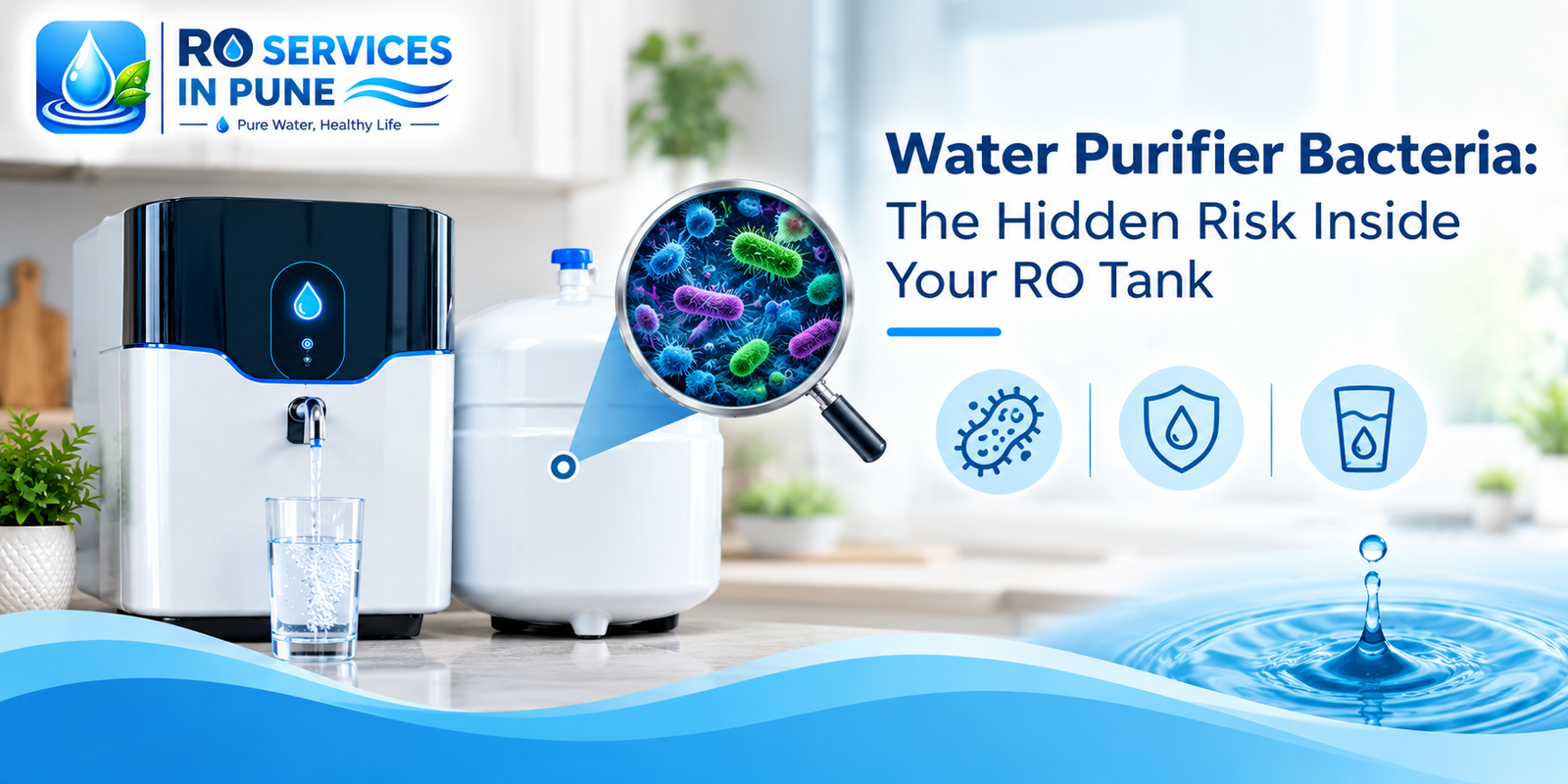
Most people assume that once water passes through their RO membrane, it’s clean — full stop. But there’s a step after filtration that quietly determines whether that water actually stays safe until you drink it: what’s happening inside your storage tank. Water purifier bacteria doesn’t come from a faulty filter or a bad membrane. It grows in the tank itself, often for months, without a single visible sign.
This is the part of RO ownership almost nobody thinks about, and it’s exactly why understanding water purifier bacteria matters as much as understanding your filter schedule.
Why Water Purifier Bacteria Grows Even After Filtration
Once purified water leaves the membrane, it doesn’t go straight to your glass — it sits in a storage tank until you use it. That tank is a static, enclosed environment, and static water is exactly the condition bacteria need to establish themselves. Even water that was perfectly filtered a moment ago can pick up biofilm growth on the tank walls over time, especially if the tank hasn’t been sanitized in months.
This is the core problem with water purifier bacteria: it isn’t a filtration failure. Your membrane did its job. The risk shows up afterward, in a part of the system most households never think to clean.
How Water Purifier Bacteria Actually Builds Up
Bacteria doesn’t appear overnight. It typically starts as a thin, almost invisible film — what’s often called biofilm — forming on the interior tank walls. Left undisturbed, this film thickens over weeks and months, particularly in warmer conditions or when water sits for long stretches between use, such as in smaller households or offices with lower daily consumption.
Mineral deposits from hard water can accelerate this process, giving bacteria more surface area to cling to. Once biofilm establishes itself, it becomes progressively harder to dislodge with anything short of a proper sanitization process — rinsing the tank with plain water simply isn’t enough to remove it.
Signs You Might Have Water Purifier Bacteria Building Up
The tricky part about water purifier bacteria is that it rarely announces itself clearly. Watch for:
- A stale, musty, or slightly “off” smell in stored water, even though the purifier just filtered it
- A flat or faintly unpleasant taste that wasn’t there a few months ago
- Water that looks perfectly clear but doesn’t taste the way it used to
- No improvement in taste even after a recent filter change
That last point is worth sitting with. Many households, when they notice a taste change, assume it’s a filter problem and book a filter replacement — only to find the taste issue persists, because the actual cause was never the filter to begin with.
Why Filter Changes Alone Won’t Fix This
It’s a common and understandable mix-up: if water tastes off, the instinct is to blame the filter. But filters and membranes address what’s in the incoming water — sediment, chlorine, dissolved solids. They have no bearing on what’s growing inside your storage tank after purification. If you’ve recently had a filter change and the taste issue hasn’t gone away, it’s worth checking how often your filter actually needs changing to rule that out — but if your filter schedule is already on track, the tank is very likely where the real problem sits.
This is exactly why RO water purifier maintenance needs to include the tank, not just the filtration stages. A purifier that’s perfectly maintained on the filter side can still deliver bacteria-affected water if the tank behind it has been neglected.
What Sanitization Actually Removes
Proper tank sanitization isn’t the same as water purifier tank cleaning in the sense of a quick rinse. It involves fully draining the tank, physically scrubbing the interior to break down existing biofilm, and applying a food-safe sanitizing solution that’s left to work before being thoroughly flushed out. This combination — mechanical cleaning plus sanitization — is what actually addresses water purifier bacteria at its source, rather than just masking the symptoms.
Skipping this step doesn’t just risk taste and odor issues. Over time, unchecked biofilm buildup can also affect the tank’s outlet valve and reduce effective storage capacity, compounding into a maintenance issue that’s more involved to fix the longer it’s ignored.
How Often This Should Be Done
For most households, tank sanitization every 6 months is enough to stay ahead of bacterial buildup, though homes using harder groundwater or borewell water as their primary source may need it more frequently, since mineral scaling tends to accelerate biofilm formation. If you’re wondering how to clean an RO tank properly rather than attempting it yourself, a professional visit typically takes under an hour and includes a full inspection, not just a surface clean.
Why DIY Cleaning Often Falls Short
It’s tempting to try addressing water purifier bacteria with a home remedy — vinegar rinses, baking soda, or simply refilling the tank more often. These approaches might reduce visible buildup slightly, but they rarely eliminate established biofilm, and none of them offer the same sanitizing effect as a proper food-safe solution applied and flushed correctly. Worse, an incomplete DIY clean can sometimes just redistribute the biofilm rather than removing it, giving a false sense that the problem’s been solved.
The Bigger Picture: Filtration Isn’t the Finish Line
It’s worth remembering that an RO system is really two separate jobs working together: filtering the water, and then storing it safely until you use it. Most maintenance conversations focus entirely on the first job — filters, membranes, TDS levels — while the second job, tank hygiene, gets overlooked simply because it’s less visible. Water purifier bacteria is the direct consequence of that gap.
Treating tank sanitization as a routine part of RO ownership, alongside filter and membrane checks, closes that gap. It’s a small addition to your maintenance schedule that protects the entire point of having a purifier in the first place — water that’s actually safe by the time it reaches your glass, not just safe the moment it leaves the membrane.
Bringing It Together
If your water has started tasting or smelling slightly different, and a filter change hasn’t resolved it, water purifier bacteria in the storage tank is one of the most overlooked explanations — and one of the easiest to fix once identified. A proper sanitization visit addresses the actual cause, rather than another round of filter replacements that were never going to solve a tank-side issue.
If it’s been more than 6 months since your tank was last cleaned, or you’re simply not sure, it’s worth getting it checked before assuming your filtration system is at fault. Get in touch to schedule a tank inspection and sanitization visit.
Frequently Asked Questions
It’s possible — bacteria buildup doesn’t always change taste noticeably in its early stages, which is why routine tank sanitization every 6 months is recommended rather than waiting for symptoms to appear.
Not usually. Filters and membranes handle what’s in the incoming water, while bacteria growth happens afterward, inside the storage tank — so this issue can occur even with a perfectly functioning filtration system.
Home remedies may reduce some visible buildup, but they rarely eliminate established biofilm the way a proper food-safe sanitizing solution does, since biofilm needs both mechanical scrubbing and sanitization to be fully removed.
If you’ve recently changed your filter and the taste or smell issue hasn’t improved, the tank — not the filter — is the more likely cause, since filter changes don’t address what’s already growing in stored water.
Yes — mineral scaling from harder water sources gives bacteria more surface area to cling to inside the tank, which is why households on borewell water often need more frequent sanitization than those on softer municipal supply.