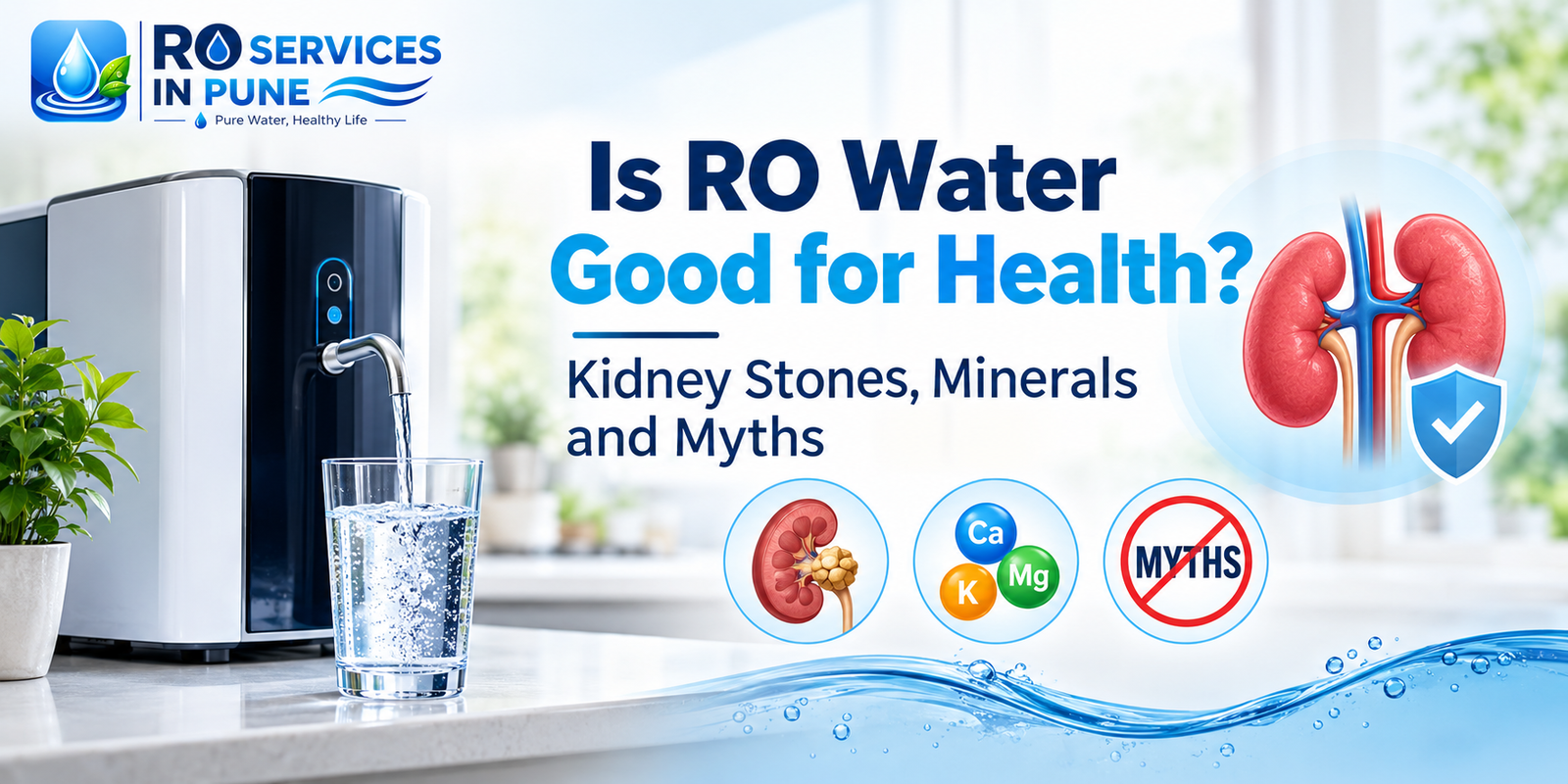
Yes, RO water is generally safe and healthy to drink when your source water needs treatment and your purifier is well maintained. For most Pune and PCMC homes using borewell, tanker or high-TDS supply, RO is a sound choice. Problems usually come from untreated water, a badly adjusted TDS or a neglected purifier, not from reverse osmosis itself.
If you have ever wondered whether RO water is good for health, causes kidney stones or strips minerals from your body, this guide separates the myths from what is reasonably well understood. We are RO Services Pune, an independent multi-brand RO service provider with 18+ years of experience across Pune and PCMC, so we also tell you when you may not need RO at all. This article is general information, not medical advice.
Is RO Water Good for Health? The Two Conditions That Decide It
For most Pune households the answer is yes, as long as two conditions are met.
- Your source water needs it. RO is useful when water has high dissolved solids, hardness or similar issues, which is common with borewell and tanker water.
- The system is maintained. Old filters, a scaled membrane or a dirty storage tank can undermine the water you pay to purify.
In the other direction, if your supply already has low TDS and no contamination concern, an RO system may be more than you need.
What Does an RO Purifier Remove from Drinking Water?
A reverse osmosis membrane pushes water through a semi-permeable barrier that restricts many dissolved substances. Depending on the system, it can reduce things like excess salts, hardness minerals and certain heavy metals. A full purifier also uses sediment and carbon filters, and often UV or UF, to deal with particles, taste and microbes.
The catch is that the membrane is not selective in a human sense. It reduces many dissolved minerals, including calcium and magnesium, along with the unwanted ones. That is why minerals are the centre of the RO health debate.
Does RO Water Cause Kidney Stones?
This is the question behind many searches for does ro water cause kidney stones, and the evidence does not support a direct link. Kidney stones form when urine becomes concentrated and minerals such as calcium and oxalate crystallise. The most common trigger is not drinking enough fluid, which is why kidney stones and drinking water are linked mainly through how much you drink, not whether the water went through RO.
What matters more:
- Hydration. Doctors commonly advise people prone to stones to drink enough to pass roughly 2 to 2.5 litres of urine a day. Your own target depends on your history, climate and doctor’s advice. Searches such as kidney stones and water intake and water intake for kidney stones are really asking this.
- Diet. Salt, animal protein and oxalate-rich foods influence stone risk. Calcium from food can actually help bind oxalate in the gut.
- Your stone type. Different stones have different triggers, which is why your doctor’s advice matters more than any water rule.
So the question is not is RO water good for health versus bad for kidneys. For stone prevention, drinking plenty of clean, safe water matters most, and RO is one way to make source water safer to drink in quantity.
Does Hard Water Cause Kidney Stones?
Many people assume hard water must cause stones because it is rich in calcium. The research on hard water and kidney stones is mixed, and large reviews have generally not found water hardness to be a major driver for most people. Some studies even suggest higher magnesium in water may be protective, while a few report small risks in specific groups. The honest summary is that hardness is a minor factor compared with hydration and diet.
Hard water still causes real, visible problems at home: scale on taps and geysers, stiff laundry, dull hair and skin, and faster scaling inside appliances. If that is your concern, a softener is the right tool, not a health scare.
Does RO Water Have Side Effects? Myth vs Reality
Searches for side effects of ro water, ro water disadvantages and is ro water not good for health mix a few real points with several myths.
| Claim | What is reasonably true |
| RO water causes mineral deficiency | Most of your daily minerals come from food, not water. Problems are more likely with very low-mineral water over a long time and a poor diet. |
| RO water is acidic and harmful | RO water can be slightly acidic and taste flat, but it is not toxic. A mineral cartridge or TDS controller improves this. |
| RO water causes kidney stones | No direct link is established. Hydration and diet matter far more. |
| RO wastes a lot of water | True for many systems. Reject water can be reused for mopping, plants or washing. |
| Any RO purifier is automatically safe | Not if filters are overdue, the membrane is scaled or the tank is dirty. |
Health bodies, including the WHO, have cautioned against relying long term on completely demineralised water without any mineral adjustment. That is a reason to manage the TDS of your RO output, not a reason to avoid RO where your source needs it.
Does Your Pune Home Need RO? Municipal, Borewell and Tanker Water
Whether is ro water purifier good for health in your case depends on where your water comes from.
- Municipal water: often lower in dissolved solids, so RO may be optional. A UV or UF purifier, or a basic filter, can be enough in some homes.
- Borewell water: commonly higher in TDS and hardness, and this is where RO usually earns its place.
- Tanker water: quality varies widely by supplier, so test before deciding.
- Stored water: even good water can pick up bacteria from a dirty overhead tank.
Water quality in Pune and PCMC varies by area, building and season, so a neighbour’s result may not match yours. So is RO water good for health in Pune? It is when the water coming in justifies it. The only reliable way to know is to measure. Our on-site water quality testing checks your actual source water, so you buy or keep RO based on facts, not guesswork.
Hard Water, TDS and RO: What to Check
High TDS and hardness often go together, which is why people search for hard water tds level, soften drinking water and water hardness treatment. A TDS meter shows dissolved solids, not exactly what those solids are, so it cannot tell you the full story on its own. As a general guide, the BIS drinking water standard (IS 10500) lists 500 mg/L as the acceptable limit for TDS, and WHO describes water below about 300 mg/L as having excellent taste. Our guide to the safe TDS level for drinking water explains how to read the number properly.
In very hard water, RO membranes and tanks scale up faster and need more frequent care. Where hardness is heavy, installing a water softener before the purifier protects the system and the water it makes.
How Can You Make RO Water Healthier?
- Check the output TDS. Very low TDS (often under about 50 ppm) can taste flat. Many households aim for a moderate range, and the right level depends on your source, so ask your technician what suits your system.
- Use a mineral cartridge or TDS controller if your purifier supports one. The mineral contribution varies by product, so do not treat it as a guarantee.
- Service on time. Replace filters and the membrane based on actual water quality and usage, not a fixed calendar.
- Sanitise the storage tank periodically to prevent bacterial growth.
- Eat for your minerals. Dairy, leafy greens, nuts and whole grains supply what water cannot.
- Drink enough. Especially if you have had kidney stones.
If you would rather not track filter dates yourself, an RO AMC plan is one way to keep servicing on a regular schedule.
When to Speak to a Doctor First
Please take medical advice, not just water advice, if you have a history of kidney stones, chronic kidney disease, or any condition where your doctor has set fluid or mineral limits. Infants on formula and people on restricted diets should also follow their doctor’s guidance about water and minerals.
So, Is RO Water Good for Health?
In most Pune and PCMC homes with borewell, tanker or high-TDS supply, yes, RO water is good for health as long as the TDS is sensible and the purifier is well maintained. It does not cause kidney stones on its own, and hard water is a minor factor compared with how much you drink. If you are unsure what your water needs or your purifier has not been checked in a while, book an RO service in Pune and we will inspect the system and talk you through the options.
Frequently Asked Questions
Yes, for most households where the source water needs treatment and the purifier is well maintained. Pair it with a balanced diet, since food, not water, is the main source of your daily minerals.
Yes. The RO membrane reduces many dissolved minerals, including calcium, magnesium and potassium, along with unwanted salts. A mineral cartridge or TDS controller can add some back, and a balanced diet covers the rest.
There is no solid evidence that RO water leaches minerals out of your body. The realistic concern is that very low-mineral water adds little to your intake. With a balanced diet, a deficiency from RO water alone is unlikely. Children, older adults and people on restricted diets should ask their doctor.
For most healthy people, properly maintained RO water has no proven side effects. The real drawbacks are a flat taste, low mineral content, reject water and contamination from overdue filters or a dirty tank.
No direct link has been established. Stones are driven mainly by low fluid intake, diet and individual factors, so drinking enough safe water matters most. If you have had stones before, follow your doctor’s advice.