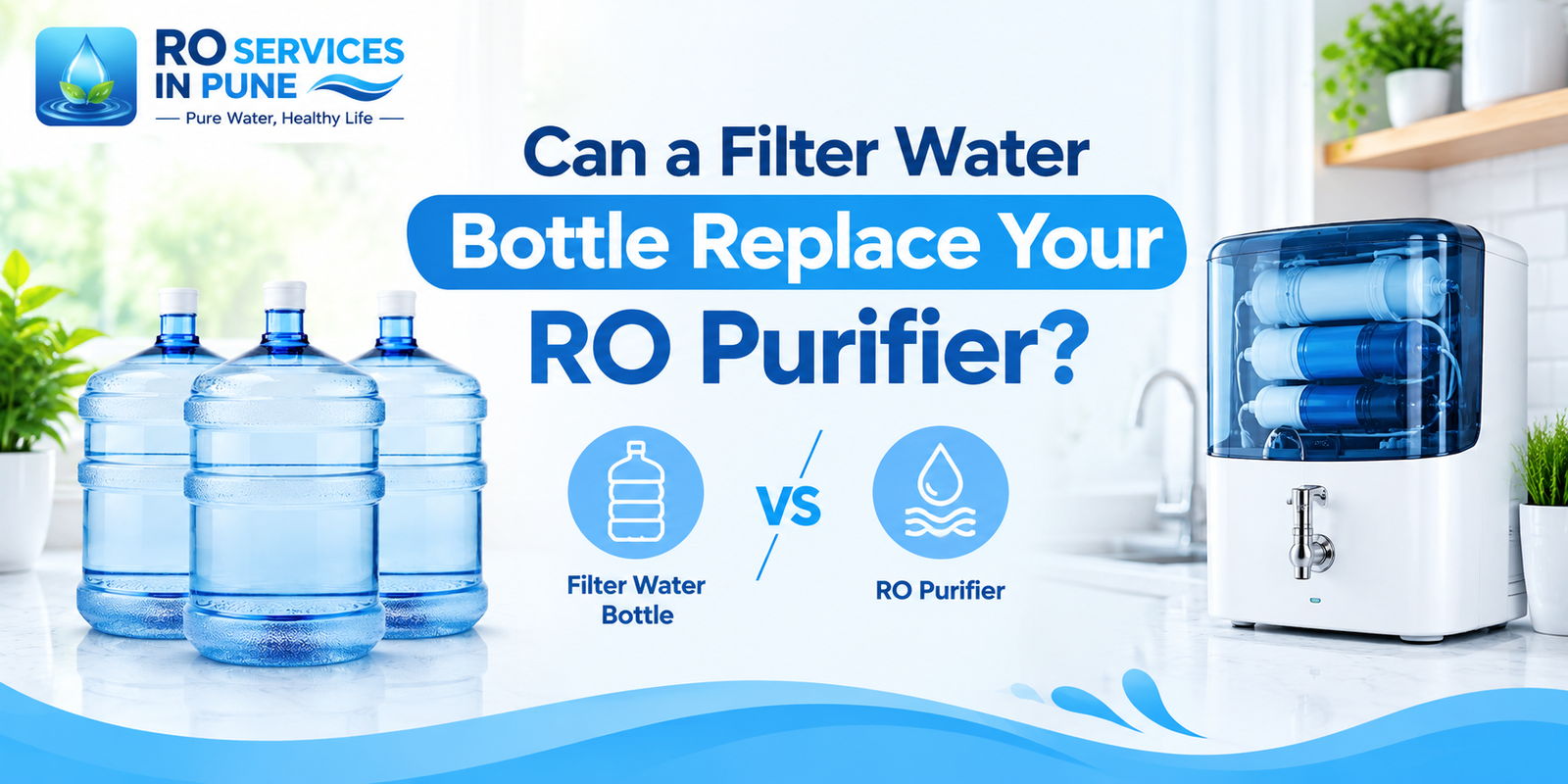
You’re heading out the door, and clipped to your bag is a sleek filter water bottle that promises clean water anywhere. Then a thought crosses your mind: if this can clean water on the go, why keep paying for RO servicing at home?
It’s a fair question. The short answer is that for everyday drinking water in most Pune homes, a filter water bottle can’t replace an RO purifier. The two are built to solve different problems. A bottle mainly improves taste and smell and, in some designs, may help reduce microbes. An RO purifier is designed to deal with what’s dissolved in the water, and that’s exactly where much of Pune’s borewell and tanker supply tends to be harder to manage.
Let’s look at how the two really differ, where each one makes sense, and how to decide for your own home.
How Does a Water Filter Bottle Work?
Most bottles use one or both of two stages. The first is an activated carbon filter. Carbon traps chlorine and some organic compounds, which is why it can make tap water taste and smell better. It also catches larger particles like sediment.
The second is a hollow-fibre or ultrafiltration (UF) membrane. Its pores are very small, but not small enough to block dissolved salts. Depending on the design, it may help reduce bacteria and protozoa, which is why these bottles are popular for trekking and travel.
Think of a water purifier bottle as a smart strainer. It removes what is floating or suspended in the water, plus some of what causes a bad taste. It doesn’t change the water’s chemistry, so whatever is dissolved in the water mostly passes straight through.
What an RO Purifier Does Differently
Reverse osmosis pushes water under pressure through a semi-permeable membrane with extremely fine pores. Water molecules pass through, while a large share of dissolved salts, hardness-causing minerals and many heavy metals are held back and flushed away as reject water. Home RO systems usually add pre-filters and often a UV or UF stage for microbes, so one unit covers several jobs at once.
That is the real difference in the carbon filter vs RO question. Carbon and UF clean up taste and what’s floating in the water. RO changes what’s actually dissolved in it. When the water coming into your home has a high level of dissolved solids, only the second approach makes a meaningful difference.
Does a Water Filter Bottle Remove TDS?
In general, no. TDS, or total dissolved solids, is a measure of the salts and minerals dissolved in your water. Carbon and UF stages aren’t designed to pull those out, so a TDS meter will usually show little or no change before and after a bottle.
That matters because dissolved solids are often higher in borewell and tanker water. Our guide to TDS levels for drinking water explains what the numbers mean, and the Bureau of Indian Standards lists 500 ppm as the acceptable limit for drinking water, allowing higher values only where no better source is available. If your supply sits well above that, a bottle won’t bring it down.
Here’s a quick side-by-side:
| Filter water bottle | RO purifier | |
| Taste and smell | Improves | Improves |
| Dissolved salts (TDS) | Little to none | Reduces significantly |
| Hard water | Doesn’t address it | Reduces hardness minerals |
| Bacteria | May reduce, depending on model | Usually handled with a UV or UF stage |
| Capacity | Typically under a litre per fill | Continuous supply from a tank |
| Upkeep | Replace cartridge, wash bottle often | Periodic filter and membrane changes, plus servicing |
| Best for | Travel, gym, office, emergencies | Daily home drinking and cooking |
Is There a Reverse Osmosis Water Bottle?
You may have come across products described as a reverse osmosis water bottle. Here’s the practical problem: true RO needs pressure to push water through the membrane, and a way to flush away the rejected water. That’s why home systems use a pump, a tank and a drain line. A bottle you carry in your hand has none of these.
As far as we know, bottles sold under this label usually rely on carbon or UF filtration instead. Read the specifications carefully, and don’t assume the bottle reduces TDS. If the label doesn’t state tested dissolved-solids reduction, treat it as a taste-and-microbe filter, not a replacement for your home RO.
Where a Filter Water Bottle Falls Short at Home
Even if the water tastes good, a bottle runs into limits quickly in daily household use.
- It doesn’t tackle dissolved solids or hardness, which are common concerns in borewell and tanker water across Pune and PCMC.
- Volume is a problem. A family needs several litres a day for drinking, tea, rice and dal. Refilling a bottle isn’t a realistic way to supply that.
- Cartridges wear out. Every bottle filter has a rated capacity, often a few weeks to a few months of regular use, so check the manufacturer’s guidance. Once it’s spent, there’s usually no obvious sign.
- Hygiene needs attention. A damp bottle and a used filter can build up bacteria if they aren’t cleaned and dried regularly.
The simplest way to stop guessing is to test your water. A TDS reading and a basic quality check show what’s actually coming out of your tap, and a professional on-site test can do exactly that at your home.
When a Filter Water Bottle Makes Sense
None of this makes the bottle a bad product. It’s simply a different tool. A filter water bottle works well when:
- You’re travelling or trekking and don’t know the water source.
- You want better-tasting water at the gym, office or on your commute.
- You’re dealing with a short-term emergency, such as a supply disruption or flooding.
- Your home supply is already low in dissolved solids and you only want to take the chlorine taste out.
A good portable water filter is also worth keeping in your emergency kit, especially during the monsoon. Treat it as a backup, not a substitute for the purifier at home.
How to Decide for Your Home
Start with the water, not the product.
1. Check your TDS. A basic meter gives you a quick reading. As a rough guide, higher readings point toward RO, while lower ones leave more room for simpler options. A professional test goes further and looks at hardness and other contaminants.
2. Know your source. Borewell, tanker and mixed supplies usually carry more dissolved solids than treated municipal water.
3. Think about volume. If the water is for your whole family’s drinking and cooking, you need a system with a tank, not a bottle.
4. Be honest about upkeep. Both options need regular care, but an RO with a scheduled service is easier to keep on track than remembering to swap a cartridge.
If your readings are low and your needs are light, a bottle or portable water filter may be enough for the occasional extra. If not, an RO purifier is the dependable choice.
When It’s Time to Move to an RO
If you’ve been relying on a filter water bottle at home because you weren’t sure what else to do, a proper RO is probably your next step. The right model depends on your water’s TDS, the number of people at home and the space you have under the sink or on the wall. Our RO installation and relocation service covers everything from checking your water to fitting the unit.
Not sure which way to go? Talk to our team and we’ll help you pick a setup that suits your water and your home.
A filter water bottle is a great travel companion. For the water your family drinks every day, an RO purifier set up for your actual supply is still the safer bet.
Frequently Asked Questions
A water filter bottle passes water through carbon and, in some models, a UF or hollow-fibre membrane, so it mainly improves taste and may help reduce microbes. An RO purifier forces water under pressure through a semi-permeable membrane, which reduces dissolved salts as well. In the carbon filter vs RO comparison, one cleans up the water and the other changes what is dissolved in it.
A water purifier bottle with carbon typically reduces chlorine, odour and sediment, and a UF or hollow-fibre model may help reduce bacteria and protozoa. It generally doesn’t reduce dissolved salts, hardness or most dissolved heavy metals. An RO purifier is designed to reduce all of these, and most home units add a UV or UF stage for microbes. Results vary by model, so check the product’s tested claims.
A bottle costs less upfront, but its cartridge has a short life and must be replaced regularly, and the bottle itself needs frequent cleaning. An RO costs more to install, but one unit serves the whole household, with periodic filter and membrane changes plus servicing. For daily family use an RO is usually the more practical option, while a bottle suits occasional use.
A home RO purifier sends some water to the drain as reject water, and the amount varies with the model, the membrane’s condition and your water’s TDS. A filter bottle doesn’t produce reject water. As far as we know, products sold as a reverse osmosis water bottle use carbon or UF filtration instead of true RO, so they don’t have a reject stream either. If waste water concerns you, ask your technician about the reject ratio and reuse the reject water for cleaning or plants.
For daily drinking and cooking at home, especially with borewell or tanker water, an RO purifier is the dependable choice. A water filter bottle or another portable water filter is best for travel, the gym, the office or emergencies. Test your TDS first, then choose based on your water, your family size and how much upkeep you can manage.