If you’ve ever looked at your RO purifier’s display and seen a number like “82” or “140” without knowing what it actually means, you’re not alone. Understanding TDS level for drinking water is one of those things almost every RO owner encounters but few people fully understand — and getting it wrong, in either direction, can affect both your health and your wallet.
What TDS Actually Measures
TDS stands for Total Dissolved Solids — it’s a measurement, in parts per million (ppm), of everything dissolved in your water that isn’t actually water. This includes minerals like calcium and magnesium, salts, and in some cases, contaminants depending on your water source. A higher number doesn’t automatically mean “dirty” water, and a lower number doesn’t automatically mean “safe” water — which is exactly where most confusion around TDS level in drinking water begins.
So What Is TDS in Water, Really?
To answer the common question of what is TDS in water simply: it’s a snapshot of how much “stuff” is dissolved in a given sample. Municipal water, borewell water, and RO-purified water will all show different TDS readings depending on their source and how much filtration they’ve been through. This is why two homes on the same street can show noticeably different numbers — pipe age, storage tanks, and even seasonal changes all affect the reading.
What’s Actually Safe: Breaking Down the TDS Ranges
Here’s where most people actually want a straight answer, so let’s give one:
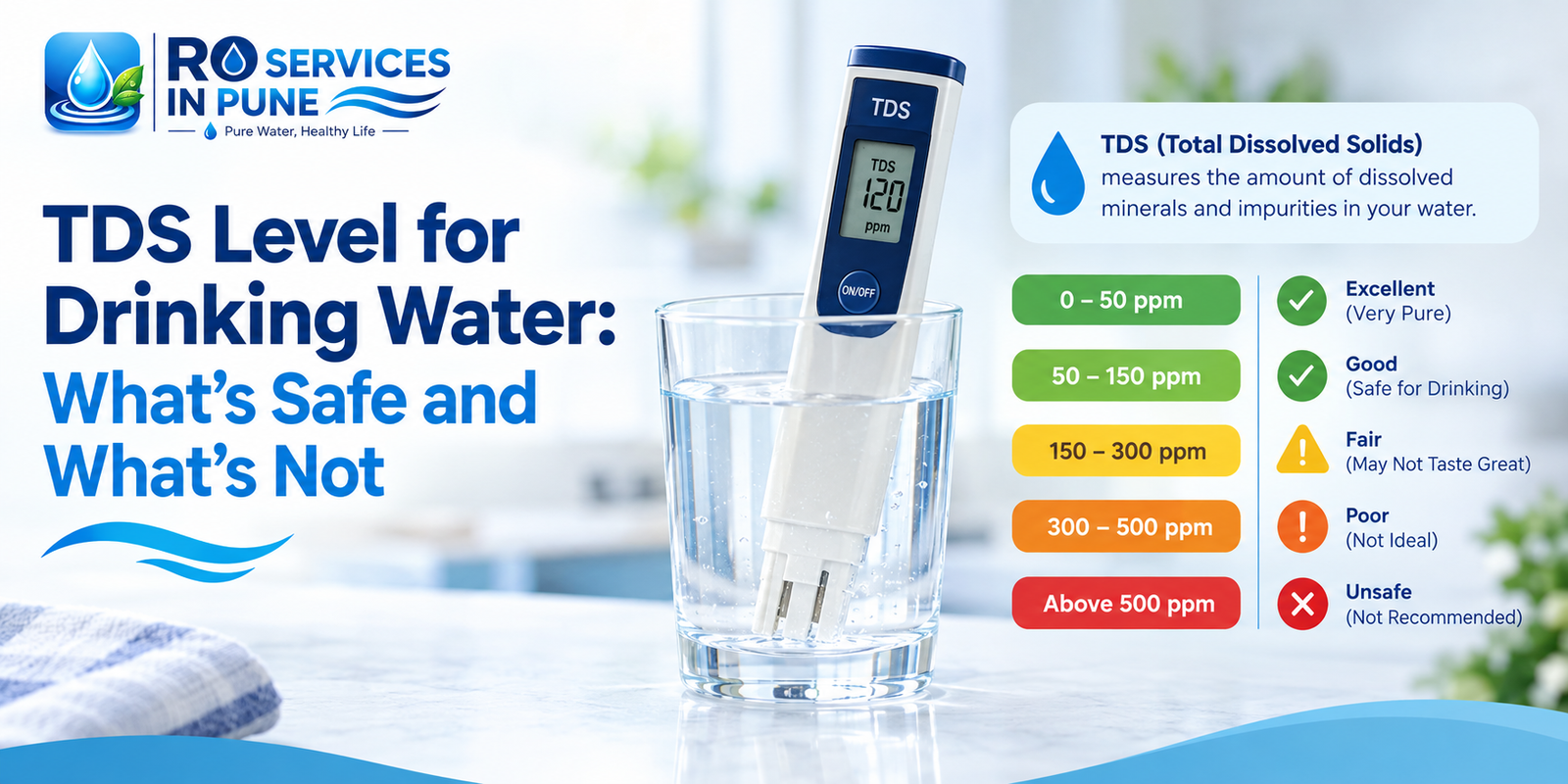
- Below 50 ppm — This is generally considered over-purified. Water in this range often tastes flat or slightly odd, because most of the natural minerals have been stripped out along with the contaminants. This is common with older RO systems running without a mineralizer cartridge.
- 50–150 ppm — This is considered the ideal TDS level for drinking water by most Indian water quality guidelines. It typically means the water has enough dissolved minerals to taste normal while still being safe from a contamination standpoint.
- 150–500 ppm — Still generally acceptable for drinking, though water on the higher end of this range may start to taste slightly different, and this range often prompts people to check whether their purifier needs attention.
- Above 500 ppm — This is classified as poor by most drinking water standards and typically requires a high-rejection membrane paired with proper pre-treatment to bring it down to a safe range.
If you’re wondering about your own RO water TDS level specifically, the same 50–150 ppm range applies as the target for purified output — anything meaningfully outside that window is worth investigating.
High TDS Water: What It Actually Means
High TDS water doesn’t necessarily mean the water is unsafe to drink, but it usually points to elevated mineral content — often from borewell or groundwater sources — and it puts extra strain on your RO membrane over time. A membrane that’s constantly filtering high TDS water works harder and typically needs replacement sooner than one filtering water within a normal range.
Low TDS Water: The Other End of the Problem
On the flip side, low TDS water — especially readings consistently under 30–40 ppm — can mean your purifier is stripping out more than necessary. Over time, drinking water with very low mineral content isn’t inherently dangerous for most people, but it’s not ideal either, since minerals like calcium and magnesium in water contribute in small ways to daily dietary intake. If your purifier consistently produces very low TDS, it’s often a sign the membrane configuration doesn’t match your source water’s actual TDS level.
How to Check TDS of Water Yourself
Many people ask how to check TDS of water without professional help. Handheld digital TDS meters are widely available and give you a quick reading by dipping the probe into a water sample. They’re useful for a rough, at-home check between professional visits, though they only measure TDS — they won’t tell you about pH, hardness, residual chlorine, or other factors that matter just as much for understanding your overall water quality.
TDS Alone Doesn’t Tell the Whole Story
This is the part that trips up a lot of people: TDS in water is only one piece of the picture. Two water samples can show the exact same TDS reading and still be completely different in terms of hardness, pH balance, or chlorine content. For example, hard water — high in calcium and magnesium — can register a moderate TDS reading while still causing scaling on taps, appliances, and RO membranes. If you’ve noticed scaling or skin and hair issues at home, that’s a hardness problem specifically, not something a TDS number alone would fully explain.
Why a Single Number Isn’t Enough to Act On
If your purifier’s TDS display shows a reading that seems off, or you’re relying only on a basic handheld meter, it’s easy to draw the wrong conclusion. A number alone doesn’t tell you whether the issue is your source water, an aging membrane, or a completely different parameter like hardness or residual chlorine. This is exactly why a full water quality testing visit checks multiple parameters together, rather than relying on TDS in isolation — it gives you the context a single number can’t.
When to Actually Worry About Your TDS Reading
You don’t need to test constantly, but a few situations are worth paying attention to:
- Your purifier’s TDS display has noticeably crept upward over recent weeks or months
- You’ve recently switched water sources, moved homes, or had a new borewell connection installed
- Your water tastes noticeably different than it used to, even though nothing else has changed
- You’re unsure whether your existing purifier is actually reducing TDS as expected
Any of these are reasonable triggers to get your water properly tested rather than guessing based on taste alone.
Bringing It Together
Understanding your TDS level for drinking water doesn’t require a chemistry background — just knowing the basic ranges and what they actually mean for your household. The ideal target for purified drinking water sits comfortably between 50 and 150 ppm, with readings well outside that range usually pointing to either an over-purifying system or one that isn’t keeping up with your source water’s actual TDS level.
If you’re not sure where your own water currently stands, get in touch to book a full water quality check — it takes the guesswork out of a number that, on its own, only tells part of the story.
Frequently Asked Questions
Most Indian water quality guidelines consider 50 to 150 ppm the ideal range for drinking water — enough dissolved minerals for normal taste while remaining safe from a contamination standpoint.
Not necessarily — high TDS often points to elevated mineral content rather than contamination, but it does put extra strain on your RO membrane and may need pre-treatment if readings are consistently above 500 ppm.
This usually means your purifier is stripping out more than necessary, often due to a membrane configuration that doesn’t match your source water’s actual TDS level — a mineralizer cartridge or a professional check can help correct this.
A handheld meter gives a useful rough reading, but it only measures TDS — it won’t tell you about pH, hardness, or residual chlorine, all of which matter for a complete picture of your water quality.
Not always — TDS is only one parameter, and water can show a normal TDS reading while still having issues like hardness or chlorine content that a single number wouldn’t reveal.
Ppm stands for parts per million, and it tells you how many milligrams of dissolved solids are present in every litre of water. A reading of 100 ppm, for example, means there are 100 milligrams of minerals, salts, and other dissolved particles per litre — and this number directly affects both taste and how much scaling or strain it puts on your purifier over time.